Lianbinite
Lianbinite, Mineral of the Year 2025

For 2025 the “Mineral of the Year” award has been assigned to lianbinite. The mineral was discovered on specimens collected at the western end of Pusch Ridge, Santa Catalina Mountains, north of Tucson, Pima Co., Arizona, USA. The GPS coordinates of the type locality are: 32°21’42” N, 110°57’29” W, 975 m above sea level. The mineral was characterized by a mixed USA/China team leaded by Hexiong Yang (Department of Geosciences, University of Arizona @ Tucson, USA). Lianbinite belongs the class 10 of Strunz (organic minerals), being a glycolate, namely a derivative of glycolic acid, C2H4O3. Like all organic minerals, lianbinite represent the result of natural (geologic) processes involving living organisms. In this case the mineral originates from evaporation process of fluids containing glycolic acid and ammonium derived from plants or bacterial activities.

So far 10 mineral species belonging to the glycolate group have been described. All of them were found at the same locality (Santa Catalina Mountains), and all of them were discovered in the last years: lazaraskeite (2019), stanevansite (2022), jimkrieghite, lianbinite, gleckerite (2023), domitrovicite, rasmussenite (2024), fuchunite, puschridgeite, henrysunite (2025).Lianbinite is the first case of mineral containing two different forms of glycolate units: the glycolate anion (C2H3O3)– and the glycolic acid molecule (C2H4O3). All other minerals contain the former unit only (but fuchunite, which was discovered two years after lianbinite).
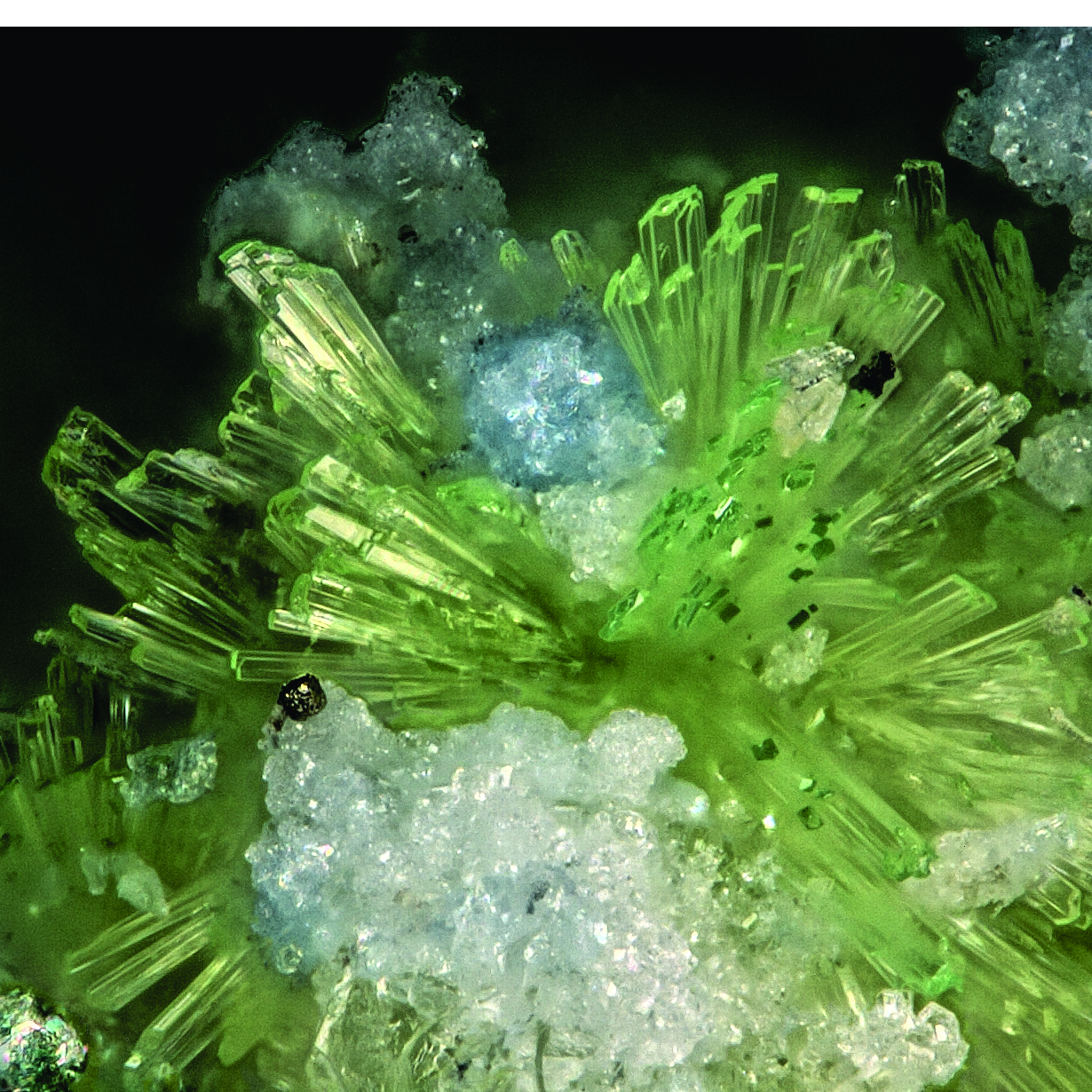
Lianbinite occurs as bladed or acicular crystals up to 0.60×0.08×0.03 mm in dimensions. Crystals are colorless, transparent, with a white streak and a vitreous lustre; they are brittle and very soft, Mohs’ hardness ranging from 1 to 1.5. Density could not be measured as lianbinite dissolves in any liquid; Dcalc is 1.497 g·cm–3 (see Figure 1 and 2).


The empirical chemical formula of lianbinite is N0.98C3.97H11.06O6. Based on the information obtained from the structural analysis it can be idealized into (NH4)(C2H3O3)(C2H4O3).
The crystal structure of lianbinite has been solved and refined up to R = 0.036 in the monoclinic space group P21/c. Its unit-cell parameters are a = 3.9136(1), b = 18.7568(6), c = 10.7195 (3) Å, β = 107.479(3)°, V = 750.56(3) Å3, Z = 4. It contains a glycolate anion (C2H3O3), a glycolic acid molecule (C2H4O3), and an ammonium group (NH4) in the asymmetric unit; four molecular units are accommodated in the unit cell. The structure is unique among minerals; however, its synthetic analogue is well known (see Figure 3 and 4).
The mineral took its name after Bin Lian (b. 1964), a geomicrobiologist at the Nanjing Normal University, China, for his outstanding contributions to the understanding of interactions between minerals/rocks and microorganisms. Bin Lian authored more than 100 papers and 9 patents, has been a council member for the Chinese Society of Mineralogy, Petrology and Geochemistry since 2017, as well as a committee member for the Chinese Society of Geological Microbiology.
The concurrent occurrence of the glycolate anion and the glycolic acid molecule, never recorded so far in Nature, marks the novelty of lianbinite and led this organic mineral to earn the “Mineral of the year” award.
The full description of the new mineral has been published in the Americal Mineralogist [Yang, H., Gu, X., Lazar, W., Gibbs, R.B., Downs, R.T. (2025): Lianbinite, (NH4)(C2H3O3)(C2H4O3), a new glycolate mineral from the Santa Catalina Mountains, Tucson, Arizona, U.S.A.].
Link to the original article:
https://msaweb.org/MSA/AmMin/TOC/2025/Abstracts/AM110P1481.pdf